A couple of years ago, back when we were in the earlier stages of this filmmaking quest, Koko and I had a discussion about financing in which I ran down some of the creative methods through which other indie upstarts had raised the capital for their debut productions: Robert Townsend and the string of maxed credit cards that powered Hollywood Shuffle... Robert Rodriguez donating his body to science to make El Mariachi... Darren Aronofsky pulling together the completion funds for π by bumming $100 off of everybody he knew... Kevin Smith pawning a good portion of his cherished comic book collection to finance Clerks... Then Koko says to me: "You still have all those old records, don't you?"
"Yeah," I says. "Why?"
"You said a lot of collectors would pay good money for those things, right?"
"Yeah, I did mention that."
A tense silence fills the next few seconds, though it feels like hours. Finally, I speak: "I'm not selling my records."
"Why not? Don't you have multiple copies of a lot of them?"
"I have multiples of some of them, yes. And God willing, I will keep it that way!"
"FOR GOD'S SAKE, WHY?"
(Mind you, Koko was not asking why I was keeping multiples; he sincerely wanted to know why I kept ANY of them at all. As I've mentioned before, he has never had anything but contempt for the vast majority of Nigerian popular music and remains puzzled by my need to collect these records that he considers pure garbage.)
"You think I don't want to raise this cash, too? It's just that... Some things are more important than money."
Koko is genuinely bewildered now: "LIKE WHAT?"
At this point, I launch into a long spiel, the content of which I cannot remember. I am fairly certain, though, that it contained the phrases "guard our cultural heritage," "sell our birthright" and "FESTAC mask."
Koko is silent for a while, and then he says "Seriously... You have got to be the most un-Igbo Igbo man I have ever met in my life."
And that was that.
Well... Not really. Time and time again, the subject would intermittently re-arise, with Koko goading and pleading (and Enyi occasionally chiming in, asking what I had against making money while rhetorically questioning my Igboness), but like the eyebrows below Sylvester Stallone's Botoxed forehead in the new Rambo movie, I remained unmoved.
Flash forward to now: Some of you who shop for records on eBay might have noticed that over the past two or three months, I've occasionally been up on there hawking vinyl.
To what can we attribute my change of heart? Well...
1) Back when I first started (seriously) collecting old Nigerian records about 8 or 9 years ago, it was mostly a barren landscape. These things were hard as hell to find--even in Nigeria--and I had to go to often absurd and brutally taxing lengths just to find someone who remembered these records, let alone who could grant me access to them. Under these circumstances, I actually entertained the possibility that I was in possession of the last surviving copies of some of these albums, and I was like an ethnomusicological L.S.B Leakey digging up and preserving the fragile remains of a disappeared culture.
But with time, I've learned that it's not that deep. As the popularity of African pop music of all kinds has exploded over the past few years, all these rare vinyl nuggets have continued to come to light by the truckload, so it's not like I have to hoard and curate that much; there's enough vinyl to go round... provided you're willing to pay for it. And if so, why should you not pay me? Because, you see...
2) Comb & Razor, Inc. needs to acquire a few pieces of fairly expensive production hardware, and it's not like we can just charge it to the game. Also...
3) The amount of clutter in my pad is getting ridiculous. My sister visited this past weekend and threatened to call Niecy Nash on my ass.
So yeah... Let me officially state that I am indeed selling records, so if you want to buy them, come see about me.
Check back frequently, and add me to your favorite sellers ("combrazor" is the ID), as I'll be putting up more stuff with time. It'll probably be mostly Nigerian records of the type I post about here, though I might occasionally throw in other stuff, too. Also, feel free to hit me up with requests; I can't promise I'll be able to fill them all, but I'll try!
For some reason, I feel the need to apologize for placing this advertisement in this space: the idea of selling or shilling on this blog for my own pecuniary profit makes me cringe more than a little. But hey... The original raison d'etre of the blog was to document the making of TOO MUCH BEAUTIFUL WOMAN, and this is kinda part of that saga, so I guess I can get a pass here.
(Look at me, expressing embarrassment over mercantile activity! Seriously... What kind of Igbo man am I?)
(So... It's about time that I got back to posting blogs from the vaults and general backstory. Sorry I slacked off on this before, but things got kinda hectic during my last couple of weeks in Lagos and it actually takes a little time for me to "assemble" these entries. Pretty much all of them were written on the run, so I'll have half the entry composed on my laptop, then I got to find another quarter that's scribbled in one of my many notebooks, and locate various random paragraphs scrawled on the myriad scraps of paper constantly stuffed into the pockets of my jeans and compartments of my backpack. So organization is not necessarily my strong suit; believe me, Denis never let me hear the end of it. Anyway, let's continue with the story I was telling here.)
As it turns out, yesterday was the ninth anniversary of the death of Fela Anikulapo-Kuti. As such, there was a celebration of his life and legacy at New Afrika Shrine - the reconstituted version of the club Fela maintained as his personal court, soapbox, and alternate reality for more than two decades - as a prelude to the massive "Felabration" slated for October. Denis and I want to go to the Shrine. We're both huge Fela fans; in fact, Fela was a bit of a catalyst in our friendship. We "met" a few years ago on the Okayplayer music board when he posted a poll posing the question "Who is the most prominent African musician - Myriam Makeba, Franco, Manu Dibango or Meiway?" Outraged, I immediately fired back with "How the hell you gonna make a post about important African musicians and not include Fela?" He calmly explained to me that he didn't really know all that much about Fela, having grown up in Francophone Africa, where the influence of a figure like Franco loomed a little larger. The truth is, at the time I was just really getting about Fela's music myself.
By the time I was coming up in the 1980s, Fela was a shadow of the fiercely creative and popular musician he had been in the previous decade. Since the 1977 government-mandated firebombing of his home and the resultant death of his mother, he seemed to be become less known for his music than for his controversial public antics--the weed, the nudity, the polygamy, the blasphemy, the highly theatrical presidential campaigns, the frequent trips to jail and drawn-out court cases--kinda like 2Pac would be in the '90s. His music wasn't played much on the radio and when it was, it tended to be humourous, relatively innocuous dance records like "Open and Close" and "Excuse-O." Our government was a fairly repressive military dictatorship, and just whistling one of Fela's more anti-establishment tunes like "Zombie" within earshot of any soldier, policeman, customs officer or even a traffic warden was enough to get you beaten within an inch of the pearly gates and thrown in jail.
In the eyes of a lot of middle-class parents (like mine), messing with Fela was a gateway to a seriously fucked-up life and they endeavoured to insulate their children from his influence the same way you do your best to keep your kids away from crack pipes, stripper poles and religious cults. Because, really, that's kinda what Fela fandom was: a cult. But it wasn't just a cult full of thieves, thugs and hookers, like most people thought; its membership spanned across all walks of society, including some sectors of the government. I was a late convert: Fela didn't really capture my soul until the day I was getting on the plane to leave Nigeria in the early '90s, but now that I was back, I was looking forward to making a pilgrimage to his sacred temple. Me and Denis had planned a trip to the Shrine for a long time and this seemed the best time to make it happen.
Except that Koko wasn't trynna hear it.
Not that he's not a Fela fan; he is--hardcore. In fact, he was the one who first introduced me to "Baba 70"'s music (or tried to, anyway) back in high school, and he always has a Fela tape in the car (along with a cassette of really cheesy '80s funk & R&B and Toni Braxton's first album, which he plays specifically when he wants to torture me and Denis). As a true Fela-head, he's been to the Shrine a couple of times and he had the portent that the night's event was going to be like an area boy* homecoming festival; unless one absolutely, positively needs to experience the feeling of blood gushing from one's forehead like a geyser as multiple beer bottles shatter upon one's cranium, it might be a good idea to put a considerable distance between oneself and that general area. Me and Denis tried to persist, but Koko was the one driving and if he said we weren't going to the Shrine, then we weren't going to the Shrine.
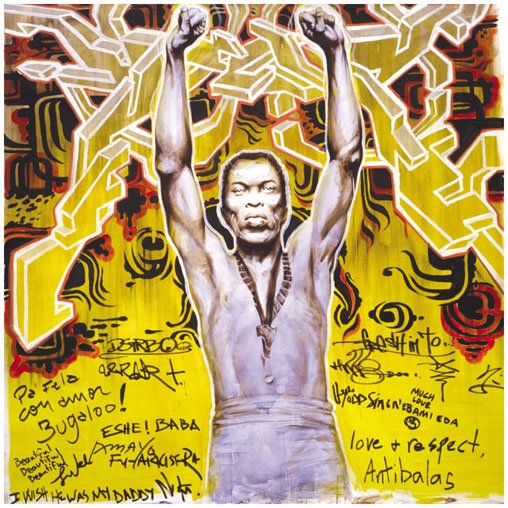
So there we were yesterday evening, sitting in the middle of one of Lagos's trademark traffic jams, listening to the radio. All the stations are playing Fela's classic jams (well, the two that weren't playing Christina Aguilera's "Ain't No Other Man" and that dreadful new Beyonce song every twelve minutes, anyway). As "Roforofo Fight" comes on, I'm reminded exactly how much Fela's music informed the creation of TOO MUCH BEAUTIFUL WOMAN. The very first scene I wrote in the script (the one where Boy scuffles in the street with the market woman Madam Kuku as a jeering crowd gathers around) was directly inspired by the abrupt, chaotic energy of this song. The second scene I wrote (which is now the first scene in the script) was inspired by "Water No Get Enemy." The go-slow scene was dictated by, of course, "Go Slow." Hell, even the fast-paced, semi-cartoonish mise-en-scene was less an attempt to emulate Guy Ritchie than it was a desire to achieve the kind of collage of vivid detail, grotesque humour and jarring juxtapositions that characterized the sleeve art Ghariokwu Lemi created for Fela's albums.
These thoughts only reinforced my belief that a visit to Fela's house would restore my sagging confidence, so I tried to gain some leverage for my case by cloaking my selfish desires in the guise of selfless professionalism:
"You know... This might be a good way to earn some much-needed production scratch. Straight No Chaser would probably pay good money for some pictures of that event."
"If you even THINK of taking a camera into that place---!!" Koko snapped. He took a breath, regained compsure and then sighed wearily. "See... That's the reason why we're not going to the Shrine. Because I don't plan to be the one to explain to your parents the events surrounding the death death of their son. Besides, weren't you the one who just had to see Yinka Davies tonight?"
Ah yes. Let's get things straight about that. While I do have the tendency to sometimes come off as an obsessive crackpot who's seen Vertigo four or five times too many, there was a fairly logical and practical reason for my yen to meet with Yinka. In fact, there were at least two such reasons:
1. At five o'clock in the morning, after two and a half hours of watching Nigerian videos that mostly looked like this
the simplicity and spirituality of Yinka's video washed over me like a moment of clarity.
[I really wish I could include a clip of the video so you could see what I'm talking about, but I just can't find it anywhere.]
2. The Koyaanisqatsi-esque montage of the video impressed upon me the fact that what I really needed to hold this film together was a powerful score like the one Philip Glass provided.
Last time we were in Lagos, a ladyfriend mentioned to me that Yinka Davies was an old acquaintance and that I should give her a call to provide some music for the movie. I wasn't that interested, though. Pretty much from the beginning, we knew what kind of music we wanted for the movie. We were aiming squarely for a retro-romantic feel, so we wanted some afrobeat by Fela (or if that turned out to be too expensive, one of the many Fela disciples) and vintage highlife, rumba and cha-cha-cha from the 1950s and '60s. The idea of using contemporary music wasn't something we had on the agenda at all. In fact, we had something of a maxim: "No jeans and no rapping!" [I'll explain the jeans thing later, fam] But all of a sudden, I felt that Yinka probably did have a certain sensibility that could add something to the vision we were trying to realize.
So I called Yinka. I found her to be warm and cordial on the phone, though she seemed a bit curious about how I had gotten her number. I told her that B____ had given it to me. I told her that I had been a fan of her work as a lead vocalist in Lagbaja's band.
"That was a long time ago," she laughed.
"I heard you were doing some stuff with the Jazzhole folks now, right?"
"Well, I've worked with them in the past... But not at the moment."
"So... uh, what else have you been up to? I heard you were on the new Tony Allen record, too."
"Oh yes! Have you heard it?"
"No... Not yet. Heard good things about it, though." [I've since heard it; here's one of the tracks Yinka features on, "Losun"]
"So what's the deal, then? What can I help you with?"
I told her that I was a filmmaker and I was looking for music for my movie. I told her about seeing her video at 5 a.m. and I hoped that I didn't sound like a crazy person.
She was quiet for a moment and then she said "Why don't you come over and see me today?"
I was quite pleased.. If she's actually inviting me over to her home, that means that I didn't sound crazy, right?
Or maybe it just meant that I did sound crazy, but that she recognized a kindred spirit.
(to be concluded) ___________________________________________________
* The “area boy” is the Naija equivalent of the “rudeboy” or “gangsta” or “generally thugged-out individual that you don’t want to mess with”