R.I.P.
This is shaping up to be a rough week for cinephiles, isn't it?

Tuesday, July 31, 2007

Monday, July 30, 2007
Ingmar Bergman (1918-2007)
Requiescat in pace.
Funny thing is that Bergman is one of those people who I always find myself thinking died years ago.
Funny thing is that Bergman is one of those people who I always find myself thinking died years ago.
Sunday, July 29, 2007
Qui sont ces Bobongo Stars?
First off: I don't know if I have words to express how shocked I was to check the DivShare stats and find out that less than 24 hours after I posted it, the PJ Gray Boogie Trip Mix had been downloaded more 400 times, making it the most DLed file I've ever put up here! Did it get cross-posted on other blogs/forums or do y'all just love disco that much? (If the latter is the case, there's more where that come from, I reckon.)
Today's another quickie drop. This is an album that John B sent me a few weeks ago (the man positively spoils me, I tell ya) but I never got around to posting it because I really don't know anything at all about the band and I wanted to dig up some background info so's I could say something more than just "Here's the music; hope you like it as much as I do! Bye!"
My research didn't lead to much, though.* All I can say for now is that they are called Bobongo Stars; they may or may not be connected in some way with Ray Lema; their drummer played with OK Jazz on the classic 1982 Franco/Sam Mangwana classic "Cooperation"; they are clearly one of the new wave of Congolese bands of the 1970s and 80s that broke the typical Congo rumba mold by evincing heavy soul, funk and rock influences.

Also, this album, Makasi, is quite the shit.

Well... Here's the music; hope you like it as much as I do! Bye!
> DOWNLOAD IT! <
*I didn't think to ask Ms Bazu if she or Guy knew anything about them, though. I should've done that.
Today's another quickie drop. This is an album that John B sent me a few weeks ago (the man positively spoils me, I tell ya) but I never got around to posting it because I really don't know anything at all about the band and I wanted to dig up some background info so's I could say something more than just "Here's the music; hope you like it as much as I do! Bye!"
My research didn't lead to much, though.* All I can say for now is that they are called Bobongo Stars; they may or may not be connected in some way with Ray Lema; their drummer played with OK Jazz on the classic 1982 Franco/Sam Mangwana classic "Cooperation"; they are clearly one of the new wave of Congolese bands of the 1970s and 80s that broke the typical Congo rumba mold by evincing heavy soul, funk and rock influences.

Also, this album, Makasi, is quite the shit.

Well... Here's the music; hope you like it as much as I do! Bye!
> DOWNLOAD IT! <
*I didn't think to ask Ms Bazu if she or Guy knew anything about them, though. I should've done that.
Friday, July 27, 2007
Chimamanda Ngozi Adichie on BBC's Hard Talk Extra
I saw this on African Shirts and I just felt the need to post it here, too.
Chimamanda's interview starts at about 2:00 minutes in.
Chimamanda's interview starts at about 2:00 minutes in.
Nigerian disco daze

Can it be I stayed away too long? Did you miss my posts while I was gone?
Been a bit busy lately, so I haven't been able to do any blogging... Fret not, family; I'll be back in full force next week.
In the meantime, I figured I'd drop a l'il somethin' to kick the weekend off right quick.
This here is "Boogie Trip," a funky (albeit too brief!) disco mix by PJ Gray of the Galactic Fractures radio show. Gray does a bang-up job, deftly pulling together a refreshingly diffuse selection, even including more than just a little dash of old skool Naija disco/boogie flavor.
Hence, sitting alongside killer cuts by The Caprells (a Jackson 5esque family band from Pittsburgh, best known amongst funk aficionados for their trippy version of "Walk On by") and Georgia's Together Band, you'll find the Esbee Family (who were probably my favorite Nigerian boogie band in the early 80s) and Doris Ebong's "Boogie Trip" (Cross River Radio, Calabar used to play this one a lot, not just on account of Doris being a local girl, but because the record is an ecstasy of funkiness).
I was particularly delighted, however, by the inclusion of Bunny Mack's "Let Me Love You," especially since I've been wanting to post up some of Mack's tracks for a while. Now I don't doubt that many of you might have attended an African party at some point during the past 27 years, and thus already have some familiarity with this hallowed slab of dancefloor dynamite; for those readers who remain innocent of its allure, allow me to elucidate:
"Let Me Love You" is, quite simply, one of the biggest African records ever. A collaboration between veteran Sierra Leonean singer Bunny Mack and London-based producer (also of Sierra Leonean extraction) Akie Deen. Deen really deserves an entry of his own, as he was a pioneer in promoting African music (and Black music in general) in the UK and was a key player during the period I sometimes call "the London era" of Nigerian music.
His main claim to fame, though, is his pan-African fusion of West Indian calypso, Brazilian samba, Sierra Leonean maringa, West African highlife and Congo rumba, sewn together with seductive disco beats and glossy production values. He called this style "discolypso," and it was quite a big deal indeed during the late 70s and early 80s.
("Ivory" by Nigerian singer Kio Amachree was another massive floor-filler in discolypso mode, though I'm not sure it was actually produced by Deen. I need to check that up.)
The release of "Let Me Love You" in a 1980 was the pinnacle of the phenomenon; the record was a bonafide international hit, reaching the number 5 slot on the UK disco charts and #76 on the singles chart, becoming an instant classic throughout most of (Black) Africa and the Caribbean, and being embraced even as far afield as Colombia.
The record has recently found new life on the international dance music scene, even inspiring remixes and remakes.
Here's the tracklisting.
1. "Boogie Trip" -Doris Ebong
2. "I Want Your Body" - Royale
3. "Listen to the Music" - Bayo Damazio
4. "The Way I Feel Rap" - Ronnie
5. "Ivory" - Kio Amachree
6. "Chics and Chicken" - Esbee Family
7. "You're Just Teasing Me" - Together
8. "What Ever Goes Up" - The Caprells
9. "Let Me Love You" - Bunny Mack
> DOWNLOAD IT! <
Thursday, July 19, 2007
By special request... The Ikenga Super Stars
This one's for you, BigDaf... Don't thank me; thank John B!
And while you're at it, thank him also for this information about the Ikenga Super Stars of Africa, filched by moi from the breathtakingly thorough African Music Home Page:
The Ikenga Super Stars of Africa, led by Vincent Okoroego, a former member of Steven Osita Osadebe's Nigeria Sound Makers, were a leading Igbo "guitar highlife" group of the seventies and eighties in Nigeria. The Ikengas called their style of music "Ikwokilikwo," a word which has also been used to describe the early recordings of Oliver deCoque and Kabaka Opara of the Oriental Brothers, among others. About the meaning of this term, Fidelis N. Umeh writes, "...'Ikwokilikwo' actually has a 'vernacular' type of meaning in the Igbo language. To set it in context, take a look at a word like 'ngwo-ngwo.' Its meaning has been derived from the act of 'igwo abacha' (preparing cassava - normally in rich oily mixing bowl), 'igwo ncha' (preparing a dish called ncha with a special type of mixing bowl), etc. It has come to be used to describe any preparation which entails the act of 'preparation in a special mixing bowl.' Ikwokilikwo is derived from 'ikwo oka' (grinding corn into pulp form), 'ikwo okpa' (grinding beans and peas into pulp form) and denotes the grinding process. The type of music to which it refers is similar in vernacular to 'cooking' used in the U.S. in the 70's to refer to really 'heavy' music in rock, jazz, blues, etc."
Ikwokilikwo in the early days at least was associated with certain classes of people, particularly traders. Its hard-driving, bouncy beat was just the sort of thing to play over a market stall sound system to attract customers! The Ikengas' LP "Ikenga in Africa" was a pan-African best-seller, combining sharp Congo-style guitar work, rhythms similar to Camerounian makossa and lyrics in "broken" or "pidgin" English, which broadened its appeal across ethnic lines. Indeed, its call-and-response recitation of the countries of Africa inspired numerous imitations, including one by the Ikengas themselves! 1976's (and 1983's) "African Unity" was a rehashed version of the same tune.
Gilbert Hsiao has provided much useful information for this updated Ikengas discography that sheds light on the history of this influential group. One question which has apparently been resolved is the relationship between the "Nkengas," who issued at least two LP's, and the Ikengas. It now seems all but certain that these are one and the same group, headed by Okoroego. But this does not answer all of the questions! It has long been rumored that "Nkengas in London" was an Osita Osadebe master tape hijacked by Okoroego and other members of the Nigeria Sound Makers who defected in the early seventies. Absent any evidence to the contrary, this seems likely. "Nkengas in London" sounds not at all like other Ikengas recordings, for instance, "Ikenga in Africa." The vocals, the instrumentation, even the spoken comments at the beginning of the songs, are all classic Osadebe. For this reason, I have listed this recording in Osadebe's discography as well as this one.
The Ikengas have had numerous personnel changes and defections over the years. A significant split occured after the band won a sizeable award from the Nigerian government for their performance at FESTAC '77 in Lagos. Guitarist Aloysius Anyanwu left to join the Oriental Brothers, and subsequently had a solo career. While the Ikengas were basically an "Igbo" group, over time they took on a broader character, enlisting musicians from other ethnic groups and Cameroun. In this sense they were part of a broader movement in Nigerian music in the late seventies and early eighties that I call "Pidgin Highlife," a trend that included artists like Prince Nico Mbarga who sang mainly in "pidgin" or "broken" English rather than vernacular languages. As this genre faded away in the early eighties, so did the Ikengas. I do not know if they are still performing as a group. - John Beadle
Ikenga Super Stars of Africa
Ikengas in Africa
Rogers All Stars, 1975

> DOWNLOAD IT! <
(I apologize for the slapdash nature of this post. I got a serious case of the busies tonight, and I also want to check out that new Mad Men show on AMC.)
(John, meanwhile, apologizes for the skips in one of the tracks; I don't think it's too bad.)
And while you're at it, thank him also for this information about the Ikenga Super Stars of Africa, filched by moi from the breathtakingly thorough African Music Home Page:
The Ikenga Super Stars of Africa, led by Vincent Okoroego, a former member of Steven Osita Osadebe's Nigeria Sound Makers, were a leading Igbo "guitar highlife" group of the seventies and eighties in Nigeria. The Ikengas called their style of music "Ikwokilikwo," a word which has also been used to describe the early recordings of Oliver deCoque and Kabaka Opara of the Oriental Brothers, among others. About the meaning of this term, Fidelis N. Umeh writes, "...'Ikwokilikwo' actually has a 'vernacular' type of meaning in the Igbo language. To set it in context, take a look at a word like 'ngwo-ngwo.' Its meaning has been derived from the act of 'igwo abacha' (preparing cassava - normally in rich oily mixing bowl), 'igwo ncha' (preparing a dish called ncha with a special type of mixing bowl), etc. It has come to be used to describe any preparation which entails the act of 'preparation in a special mixing bowl.' Ikwokilikwo is derived from 'ikwo oka' (grinding corn into pulp form), 'ikwo okpa' (grinding beans and peas into pulp form) and denotes the grinding process. The type of music to which it refers is similar in vernacular to 'cooking' used in the U.S. in the 70's to refer to really 'heavy' music in rock, jazz, blues, etc."
Ikwokilikwo in the early days at least was associated with certain classes of people, particularly traders. Its hard-driving, bouncy beat was just the sort of thing to play over a market stall sound system to attract customers! The Ikengas' LP "Ikenga in Africa" was a pan-African best-seller, combining sharp Congo-style guitar work, rhythms similar to Camerounian makossa and lyrics in "broken" or "pidgin" English, which broadened its appeal across ethnic lines. Indeed, its call-and-response recitation of the countries of Africa inspired numerous imitations, including one by the Ikengas themselves! 1976's (and 1983's) "African Unity" was a rehashed version of the same tune.
Gilbert Hsiao has provided much useful information for this updated Ikengas discography that sheds light on the history of this influential group. One question which has apparently been resolved is the relationship between the "Nkengas," who issued at least two LP's, and the Ikengas. It now seems all but certain that these are one and the same group, headed by Okoroego. But this does not answer all of the questions! It has long been rumored that "Nkengas in London" was an Osita Osadebe master tape hijacked by Okoroego and other members of the Nigeria Sound Makers who defected in the early seventies. Absent any evidence to the contrary, this seems likely. "Nkengas in London" sounds not at all like other Ikengas recordings, for instance, "Ikenga in Africa." The vocals, the instrumentation, even the spoken comments at the beginning of the songs, are all classic Osadebe. For this reason, I have listed this recording in Osadebe's discography as well as this one.
The Ikengas have had numerous personnel changes and defections over the years. A significant split occured after the band won a sizeable award from the Nigerian government for their performance at FESTAC '77 in Lagos. Guitarist Aloysius Anyanwu left to join the Oriental Brothers, and subsequently had a solo career. While the Ikengas were basically an "Igbo" group, over time they took on a broader character, enlisting musicians from other ethnic groups and Cameroun. In this sense they were part of a broader movement in Nigerian music in the late seventies and early eighties that I call "Pidgin Highlife," a trend that included artists like Prince Nico Mbarga who sang mainly in "pidgin" or "broken" English rather than vernacular languages. As this genre faded away in the early eighties, so did the Ikengas. I do not know if they are still performing as a group. - John Beadle
Ikenga Super Stars of Africa
Ikengas in Africa
Rogers All Stars, 1975

> DOWNLOAD IT! <
(I apologize for the slapdash nature of this post. I got a serious case of the busies tonight, and I also want to check out that new Mad Men show on AMC.)
(John, meanwhile, apologizes for the skips in one of the tracks; I don't think it's too bad.)
Sunday, July 15, 2007
Get Yer Ju-Ju's Out, Part 2: I.K. Dairo MBE
So since we were talking about juju music last time, I figured I might as well continue in that vein with some music from the genre's first superstar, Isaiah Kehinde Dairo MBE (1930-1996). I.K. Dairo is often referred to as"the father of juju" not because he invented the style (which he most certainly did not do) but because he took it from the lowly status of a back-alley urban folk music to a sophisticated, cosmopolitan popular genre on par with the urbane and glamorous highlife.
Like many juju musicians of the early era, Dairo started out playing music on a part-time basis while he worked as a barber and manual laborer. In 1957 he formed the ten-piece Morning Star Orchestra. The level of innovation he brought to juju was immediately apparent: He simultaneously modernized the music--incorporating cutting-edge Afro-Cuban rhythms, emphasizing the melodic role of the guitar and novel instrumental voices such as the ten-button accordion--and more deeply indigenized it via the introduction of traditional talking drums and thoroughly researched texts drawn from Yoruba folklore.
This tradition/modernity paradox also informed the subject matter of his songs, which often essayed the complexities of urban life while extolling the traditions of old. An ardent follower of the Cherubim & Seraphim "white garment" church, he advocated Protestant values even when he was singing about hip-swaying, painted-lipped city sirens. Take for example, the tune "Salome" in which he describes a beautiful, light-skinded femme fatale and then sings how it is "her character" that attracts him (LOL yeah right, dude!), and how he wants to work hard to make the money to get her.
His ambivalent relationship with urban glamour and decadence is captured in this passage from a 1969 Nigerian National Press article by Benson Corporo Okagbare:
I K has a character trait which is peculiar to him; he does not like to be interrupted when he talks and if you interrupt he will go on talking without a break in the line of thought. This peculiar character trait is much to his advantage. In any hotel, whenever he is playing and Bacchus is at work, people go very close to him. Some even go to the extent of entering on the stage to talk to him. All these do not disturb I K. In certain cases when the crowd - particularly girls, in miniskirts crowd on him while playing, he will close his eyes to avoid distraction; he prefers the audience far from the playing stage. I K is one of the greatest admirers of beauty; he has a great likeness for girls but he loves them and admires them as he would his sisters. This is another candle placed on a candlestick. I believe others will see light.
"The girls I sing of are not my girlfriends or lovers. In certain cases I pick up certain names and sing of them. Most of the characters are fictitious I am currently composing a song on Sunbo - I know nobody of such a name. I sing of girls and of 'love' because these are, in face essential factors in our lives. They are necessary compliments [sic] to whatever we are. 'Love' is indeed one of the essential ingredients of music and love songs are most appealing to all and sundry. I therefore sing them merely to give satisfaction to the people whom I am happy to see satisfied. I have carefully avoided flooding the market with such songs as they are most likely to encourage immorality." I K then concluded that if a musician was to retain his glory long he must abstain.
Dairo and his Morning Star Orchestra (renamed the Blue Spots in 1961) immediately captured the imagination of the public and rose meteorically, performing on radio and television, and becoming the favored party band among the Yoruba contingent while also drawing in fans from other ethnic groups. For his cultural contributions to the Commonwealth, Queen Elizabeth even appointed him a Member of the Order of the British Empire in 1963, making him the first and, to date (I think), the only African musician to receive such an honor.
Dairo & the Blue Spots' far-reaching appeal is documented in this article from the July 1964 issue of DRUM magazine.
His father gave him a drum to beat in his cradle. I.K. Dairo has been making music ever since. Today he is Nigeria's number one bandleader and he has been at the top for five fabulous years. How does he do it?
DAIRO IS A FIVE-YEAR WONDER
Britain has the Beatles who make teenagers scream and wail ecstatically at the slightest beat of the drums. America has pop singers like Elvis Presley and Chubby Checker whose music make [sic] her boys and girls go ga-ga. They are all worshipped by teenagers. Their grown-up fans are limited to people between twenty-five and forty years of age. But I.K. Dairo's music is a different cup of tea.

His music is not just a teenage drug, it also acts as a tonic on the grown-ups. For over five years, he has been treating the country to an unprecedented musical extravaganza--to a music that cuts across age and tribe, that is equally enjoyed by the ten year old and the septuagenarian and which gives the same kick and pleasure to the man from Lagos or from Abakaliki or from Ogbomosho or from Kaura-Namoda.
In spite of the fact that juju highhlife bands are common in Yorubaland, Dairo's music has more appeal than the music of all of them put together. It also commands more attention and respect among educated people and artists, because most of Dairo's compositions reveal a search into the past and because of their historical connections with the Yoruba folk songs.
Says Dairo: "Many older people have come to ask me for the meanings of the words I use in my songs and the majority of my Yoruba listeners are baffled at some of the incantations, verses and expressions I use. It costs me a lot of money and time to research Yoruba history and folklore. I have to travel around, talking to old men who know a lot about such things; I then go back home to turn them into modern music."

The original caption to the photo above was "DAIRO FINDS A lonely spot to compose a sad song. He says: 'I'm at the top and I mean to stay there.'"
Ironically, even as this article was rolling off the presses, Dairo's run as the King of Juju was coming to an end; 1964 was the year that a young guitar hotshot named Ebenezer Obey--lately departed from Fatai Rolling Dollar's band--formed his own seven-piece International Brothers orchestra, offering an ultramodern blend of juju-highlife, soul, country & western, Congolese rumba and an unabashed celebration of miliki, or "enjoyment" that made Dairo's studious traditionalism and Christian temperance appear hidebound and colo in comparison. Dairo managed to crank out a few hits here and there through the end of the sixties, but he really couldn't keep up with the escalated cutthroat competition amongst bands that had come to characterize the genre.
Dairo remained a beloved avuncular figure on the juju scene and given his propensity for moral messages and melodies inspired by Anglican hymnology, it was a natural move for him to put his juju ministry to service as the head of his own Aladura church, with its distinctly Yoruba brand of Christianity with a subtle orisha worship flavor.
Towards the end of his life, he also served as a professor of ethnomusicology at the University of Washington, Seattle. Upon his death in 1996, Radio Nigeria paid tribute to Dairo's standing as a sainted figure in the juju canon by playing nothing but his music for five days straight. His legacy lives on today not only through his evergreen songs, but through his son Paul IK Dairo (bka "Paul Play") who is the spitting image of his father, and one of the most popular singers in Nigeria today:
(Obviously, that "spitting image" comment was a reference to physical resemblance rather than musical. As much as Paul has expressed his disinterest in ever playing an accordion on record, the way he keeps his finger so heavy on that Auto-Tune kinda makes his vocals sound a little bit like an accordion sometimes. So in a bizarre way, he is maintaining some small piece of Baba I.K.'s musical voice, no?)
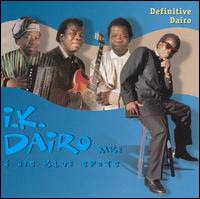
The album I'm posting here is Definitive Dairo, which probably suggests a representive anthology of his work, but the title is misleading. It's actually a lost 1971 London session that was unearthed after his death. I wish I could reproduce the lovely liner notes by juju scholar Chris Waterman, elucidating the song texts, but it's not really necessary to enjoy the music.
One thing, though; I kinda chuckled at producer Andy Frankel's efforts to rationalize the last two, Lingala-inflected songs on the disc, "Congo Kinshasa" and "President Mobutu"; he explains that the Blue Spots had just returned from Zaire, where they had enjoyed Mobutu's lavish hospitality and basically, it was a more optimistic time in Africa when nobody yet knew how the leopard-hatted one was going to wild out in coming years.
While I'm sure there's truth to this reading, I really can't ignore one aspect of the juju genre that's always kind of bothered me: Remember how I said before that juju was always sorta synonymous with toadying to me? A big part of the juju musician's repertoire has always been the ability to flatter wealthy and powerful patrons in their songs. That, to me, is some semi-feudal bullshit that I wouldn't mind seeing eradicated with all alacrity. While I know that praise-singing is a eons-old musical tradition throughout sub-Saharan Africa, so is abuse-singing (as exemplified in the modern era by Fela) and I used to be sickened by the unequivocal, oily encomium oozed by juju musicians upon robber barons, despots and other corrupt, blood-sucking reptilia (whether dressed in agbada or khaki) just as long as the money was flowing.
And that's why I found it a major head-scratcher why, when looking towards Africa for a "Third World Superstar" to replace the recently departed Bob Marley, Island Records ignored the logical choice of Fela in favor of King Sunny Ade.
King Sunny Ade? The hell?
Bob Marley became the first "Third World Superstar" because, in addition to being a gifted songwriter in the conventional pop mold, he was slick and sexy and projected the image of a real rebel against the system. This last element particularly appealed to the rock audience, which has continued to value and pay lip service to the idea of "sticking it to The Man," long after that concept ceased to have any real meaning. King Sunny Ade--apart from the fact that he didn't even sing in a language that the proposed audience could understand--he didn't stick it to The Man; he sucked up to The Man. And they were surprised that their precious rock audience didn't cotton to him the way they hoped?
...
Shit, I've wandered away from the point. I come to praise juju, not to bury it. Whatever philosophical difficulties I might have with it, it's still some good-ass music.
> DOWNLOAD IT! <
Like many juju musicians of the early era, Dairo started out playing music on a part-time basis while he worked as a barber and manual laborer. In 1957 he formed the ten-piece Morning Star Orchestra. The level of innovation he brought to juju was immediately apparent: He simultaneously modernized the music--incorporating cutting-edge Afro-Cuban rhythms, emphasizing the melodic role of the guitar and novel instrumental voices such as the ten-button accordion--and more deeply indigenized it via the introduction of traditional talking drums and thoroughly researched texts drawn from Yoruba folklore.
This tradition/modernity paradox also informed the subject matter of his songs, which often essayed the complexities of urban life while extolling the traditions of old. An ardent follower of the Cherubim & Seraphim "white garment" church, he advocated Protestant values even when he was singing about hip-swaying, painted-lipped city sirens. Take for example, the tune "Salome" in which he describes a beautiful, light-skinded femme fatale and then sings how it is "her character" that attracts him (LOL yeah right, dude!), and how he wants to work hard to make the money to get her.
His ambivalent relationship with urban glamour and decadence is captured in this passage from a 1969 Nigerian National Press article by Benson Corporo Okagbare:
I K has a character trait which is peculiar to him; he does not like to be interrupted when he talks and if you interrupt he will go on talking without a break in the line of thought. This peculiar character trait is much to his advantage. In any hotel, whenever he is playing and Bacchus is at work, people go very close to him. Some even go to the extent of entering on the stage to talk to him. All these do not disturb I K. In certain cases when the crowd - particularly girls, in miniskirts crowd on him while playing, he will close his eyes to avoid distraction; he prefers the audience far from the playing stage. I K is one of the greatest admirers of beauty; he has a great likeness for girls but he loves them and admires them as he would his sisters. This is another candle placed on a candlestick. I believe others will see light.
"The girls I sing of are not my girlfriends or lovers. In certain cases I pick up certain names and sing of them. Most of the characters are fictitious I am currently composing a song on Sunbo - I know nobody of such a name. I sing of girls and of 'love' because these are, in face essential factors in our lives. They are necessary compliments [sic] to whatever we are. 'Love' is indeed one of the essential ingredients of music and love songs are most appealing to all and sundry. I therefore sing them merely to give satisfaction to the people whom I am happy to see satisfied. I have carefully avoided flooding the market with such songs as they are most likely to encourage immorality." I K then concluded that if a musician was to retain his glory long he must abstain.
Dairo and his Morning Star Orchestra (renamed the Blue Spots in 1961) immediately captured the imagination of the public and rose meteorically, performing on radio and television, and becoming the favored party band among the Yoruba contingent while also drawing in fans from other ethnic groups. For his cultural contributions to the Commonwealth, Queen Elizabeth even appointed him a Member of the Order of the British Empire in 1963, making him the first and, to date (I think), the only African musician to receive such an honor.
Dairo & the Blue Spots' far-reaching appeal is documented in this article from the July 1964 issue of DRUM magazine.
His father gave him a drum to beat in his cradle. I.K. Dairo has been making music ever since. Today he is Nigeria's number one bandleader and he has been at the top for five fabulous years. How does he do it?
DAIRO IS A FIVE-YEAR WONDER
Britain has the Beatles who make teenagers scream and wail ecstatically at the slightest beat of the drums. America has pop singers like Elvis Presley and Chubby Checker whose music make [sic] her boys and girls go ga-ga. They are all worshipped by teenagers. Their grown-up fans are limited to people between twenty-five and forty years of age. But I.K. Dairo's music is a different cup of tea.

His music is not just a teenage drug, it also acts as a tonic on the grown-ups. For over five years, he has been treating the country to an unprecedented musical extravaganza--to a music that cuts across age and tribe, that is equally enjoyed by the ten year old and the septuagenarian and which gives the same kick and pleasure to the man from Lagos or from Abakaliki or from Ogbomosho or from Kaura-Namoda.
In spite of the fact that juju highhlife bands are common in Yorubaland, Dairo's music has more appeal than the music of all of them put together. It also commands more attention and respect among educated people and artists, because most of Dairo's compositions reveal a search into the past and because of their historical connections with the Yoruba folk songs.
Says Dairo: "Many older people have come to ask me for the meanings of the words I use in my songs and the majority of my Yoruba listeners are baffled at some of the incantations, verses and expressions I use. It costs me a lot of money and time to research Yoruba history and folklore. I have to travel around, talking to old men who know a lot about such things; I then go back home to turn them into modern music."

The original caption to the photo above was "DAIRO FINDS A lonely spot to compose a sad song. He says: 'I'm at the top and I mean to stay there.'"
Ironically, even as this article was rolling off the presses, Dairo's run as the King of Juju was coming to an end; 1964 was the year that a young guitar hotshot named Ebenezer Obey--lately departed from Fatai Rolling Dollar's band--formed his own seven-piece International Brothers orchestra, offering an ultramodern blend of juju-highlife, soul, country & western, Congolese rumba and an unabashed celebration of miliki, or "enjoyment" that made Dairo's studious traditionalism and Christian temperance appear hidebound and colo in comparison. Dairo managed to crank out a few hits here and there through the end of the sixties, but he really couldn't keep up with the escalated cutthroat competition amongst bands that had come to characterize the genre.
Dairo remained a beloved avuncular figure on the juju scene and given his propensity for moral messages and melodies inspired by Anglican hymnology, it was a natural move for him to put his juju ministry to service as the head of his own Aladura church, with its distinctly Yoruba brand of Christianity with a subtle orisha worship flavor.
Towards the end of his life, he also served as a professor of ethnomusicology at the University of Washington, Seattle. Upon his death in 1996, Radio Nigeria paid tribute to Dairo's standing as a sainted figure in the juju canon by playing nothing but his music for five days straight. His legacy lives on today not only through his evergreen songs, but through his son Paul IK Dairo (bka "Paul Play") who is the spitting image of his father, and one of the most popular singers in Nigeria today:
(Obviously, that "spitting image" comment was a reference to physical resemblance rather than musical. As much as Paul has expressed his disinterest in ever playing an accordion on record, the way he keeps his finger so heavy on that Auto-Tune kinda makes his vocals sound a little bit like an accordion sometimes. So in a bizarre way, he is maintaining some small piece of Baba I.K.'s musical voice, no?)
The album I'm posting here is Definitive Dairo, which probably suggests a representive anthology of his work, but the title is misleading. It's actually a lost 1971 London session that was unearthed after his death. I wish I could reproduce the lovely liner notes by juju scholar Chris Waterman, elucidating the song texts, but it's not really necessary to enjoy the music.
One thing, though; I kinda chuckled at producer Andy Frankel's efforts to rationalize the last two, Lingala-inflected songs on the disc, "Congo Kinshasa" and "President Mobutu"; he explains that the Blue Spots had just returned from Zaire, where they had enjoyed Mobutu's lavish hospitality and basically, it was a more optimistic time in Africa when nobody yet knew how the leopard-hatted one was going to wild out in coming years.
While I'm sure there's truth to this reading, I really can't ignore one aspect of the juju genre that's always kind of bothered me: Remember how I said before that juju was always sorta synonymous with toadying to me? A big part of the juju musician's repertoire has always been the ability to flatter wealthy and powerful patrons in their songs. That, to me, is some semi-feudal bullshit that I wouldn't mind seeing eradicated with all alacrity. While I know that praise-singing is a eons-old musical tradition throughout sub-Saharan Africa, so is abuse-singing (as exemplified in the modern era by Fela) and I used to be sickened by the unequivocal, oily encomium oozed by juju musicians upon robber barons, despots and other corrupt, blood-sucking reptilia (whether dressed in agbada or khaki) just as long as the money was flowing.
And that's why I found it a major head-scratcher why, when looking towards Africa for a "Third World Superstar" to replace the recently departed Bob Marley, Island Records ignored the logical choice of Fela in favor of King Sunny Ade.
King Sunny Ade? The hell?
Bob Marley became the first "Third World Superstar" because, in addition to being a gifted songwriter in the conventional pop mold, he was slick and sexy and projected the image of a real rebel against the system. This last element particularly appealed to the rock audience, which has continued to value and pay lip service to the idea of "sticking it to The Man," long after that concept ceased to have any real meaning. King Sunny Ade--apart from the fact that he didn't even sing in a language that the proposed audience could understand--he didn't stick it to The Man; he sucked up to The Man. And they were surprised that their precious rock audience didn't cotton to him the way they hoped?
...
Shit, I've wandered away from the point. I come to praise juju, not to bury it. Whatever philosophical difficulties I might have with it, it's still some good-ass music.

> DOWNLOAD IT! <
Sunday, July 08, 2007
Get Yer Ju-Ju's Out
When I was a kid, juju was never a musical genre that appealed to me on any significant level; I just didn't understand it. And I'm not even referring to the fact that its lyrics are pretty much exclusively rendered in Yoruba (a language of which I have almost negligible comprehension despite having scored an A-1 in it when the study of Nigerian languages in secondary schools was made mandatory in the late 80s)--I really couldn't comprehend it on a basic musical level.
But then, why should I have? I was an Igbo kid growing up in the southeastern town of Calabar; juju was a regional sound whose turf was mostly confined to the western part of the country. Point blank: if you were not Yoruba--or at least living in Yorubaland--there was little reason to give a whit about this semi-obscure lo-fi music pulsing with the accents of strange membranophones and melismata.
What's that you say? I'm overlooking the more "mainstream" juju stars like King Sunny Ade and Chief Commander Ebenezer Obey who have been able to maintain considerable popularity on a national level (and beyond)? True enough, but let's not forget that they did so by infusing their juju with more "universal" sounds like highlife, soul, afrobeat and country music. And frankly, I didn't really care much for them, either.
Part of my problem was probably the fact that (as is the case with a lot of Africans of my generation) most of my understanding of music has been founded primarily upon the appreciation of popular Western formats. As a result, it was often difficult for me to fathom any sound that I couldn't comfortably situate somewhere within the rock & roll or jazz continuua. Juju was to me (and many others like myself) colo, that is, unhip; redolent of days gone by when benighted darkies toadied before mustachioed and khaki-suited colonial maw-stuhs. In short, it was too traditional--being the opposite of "modern" and the antithesis of le sexy.
Had I been just a little bit less of an unlettered horse's hindquarters, I would have understood intutively that juju was far from "traditional" but rather was one of the first modern song styles to develop in a burgeoning urban Nigeria. Nor did it evince any of the purity that we commonly associate with "traditional" forms; it was in fact a highly syncretized genre drawing on musical idioms from various points on the West African coast and even across the Atlantic.
But like I said, most of my musical thinking centered around the West. Therefore, my journey to juju (as has been the case with my appreciation of many other indigenous African sounds) required me to zip up my boots, reverse the Middle Passage and work my way backwards to the roots (word to Lamont Dozier).
For instance, I have long adored music from South America, particularly the Afro-Cuban and Afro-Brazilian strands. Of course I knew that their intoxicating rhythms and even their idiosyncratic instruments were African retentions (or neo-African inventions) but only when I understood the story of the Aguda (or Amaros)--the Yoruba ex-slaves from Brazil and Cuba who returned to Nigeria and settled in Lagos, bringing back with them hybridized versions of African music like samba da roda, fado, burrinha and caretta--did I understand exactly how cutting-edge and mindblowingly modern juju must have seemed in the early 1930s. (I also understood why many distinguished Lagos families had names like Lopez, Fernandes, Pedro, Da Silva and Campos.)
And then you have all the other influences that shaped the development of juju: homegrown urban social musics like agidigbo, asiko, Muslim-derived sakara, Sierra Leonean palmwine music, "native blues" and colonial ballroom music and brass bands. But juju didn't really take off as a major genre until the late 1960s, during the Biafran War.
At the height of the Golden Age of Highlife in the 1950s and 60s, most of the top Lagos bands were ethnically integrated and often led by Igbos. When the Igbos all blew town during the war, Yoruba musicians were forced to look inwards, towards their own unique local forms.
This compilation, Great Juju & Sakara Music, is a snapshot of this period of self-discovery for Yoruba musicians. I'm not sure of the exact date of its release, but from the tone of the liner notes, I'm guessing that it's sometime in the very early 1970s:
Dominance of the Highlife music on West African music lovers is faultering [sic]. Other types of West African music generally associated with some set of people and regarded as underlings, are now coming into prominence. Of all these types the Juju music is seriously becoming outstanding.
Perched right under the nose of highlife, it (the highlife) will have to slice off a great part of its body to get rid of it and maintain the dominance. Presently, the juju music sounds ambitious and adamant, but the highlife music is impervious and unyielding, all to the delight of West African music lovers. Which will break the checkmate?
It will be seen that many bands now playing the juju music are off-shoots of highlife bands and it is not surprising that juju music has a little bit of similarity to highlife. However, there have been juju bands that have made names and stayed at the top but yet, there are other great bands with great juju beat, seriously seeking prominence without favour. The Fisher Music is delighted to introduce three juju bands on this album and one Sakara music band, to West African music lovers. Sakara music is one of the oldest music types in Nigeria and the particular artist on this album is a crowd-puller.
(SPOILER ALERT!! Highlife pretty much lost that standoff (at least where the nightlife in Lagos was concerned): You'll recall previous mention of Segun Bucknor's belief that juju was rapidly displacing his brand of highlife-inflected soul and funk, which led him to quit performing in 1975. More guitar-led brands of highlife--manifesting varying degrees of influence from Congolese music--continued to hold sway in the eastern part of the country, though.)
Have I rambled on too long? I feel like I have. Okay, one more thing and then I'll shut up. The last four tracks on this album (performed by Salami "Lefty" Balogun) are not juju but sakara. Please take note of the strong Islamic influence in the quavering vocal ornamentation and arabesque melody lines.

> DOWNLOAD IT! <
But then, why should I have? I was an Igbo kid growing up in the southeastern town of Calabar; juju was a regional sound whose turf was mostly confined to the western part of the country. Point blank: if you were not Yoruba--or at least living in Yorubaland--there was little reason to give a whit about this semi-obscure lo-fi music pulsing with the accents of strange membranophones and melismata.
What's that you say? I'm overlooking the more "mainstream" juju stars like King Sunny Ade and Chief Commander Ebenezer Obey who have been able to maintain considerable popularity on a national level (and beyond)? True enough, but let's not forget that they did so by infusing their juju with more "universal" sounds like highlife, soul, afrobeat and country music. And frankly, I didn't really care much for them, either.
Part of my problem was probably the fact that (as is the case with a lot of Africans of my generation) most of my understanding of music has been founded primarily upon the appreciation of popular Western formats. As a result, it was often difficult for me to fathom any sound that I couldn't comfortably situate somewhere within the rock & roll or jazz continuua. Juju was to me (and many others like myself) colo, that is, unhip; redolent of days gone by when benighted darkies toadied before mustachioed and khaki-suited colonial maw-stuhs. In short, it was too traditional--being the opposite of "modern" and the antithesis of le sexy.
Had I been just a little bit less of an unlettered horse's hindquarters, I would have understood intutively that juju was far from "traditional" but rather was one of the first modern song styles to develop in a burgeoning urban Nigeria. Nor did it evince any of the purity that we commonly associate with "traditional" forms; it was in fact a highly syncretized genre drawing on musical idioms from various points on the West African coast and even across the Atlantic.
But like I said, most of my musical thinking centered around the West. Therefore, my journey to juju (as has been the case with my appreciation of many other indigenous African sounds) required me to zip up my boots, reverse the Middle Passage and work my way backwards to the roots (word to Lamont Dozier).
For instance, I have long adored music from South America, particularly the Afro-Cuban and Afro-Brazilian strands. Of course I knew that their intoxicating rhythms and even their idiosyncratic instruments were African retentions (or neo-African inventions) but only when I understood the story of the Aguda (or Amaros)--the Yoruba ex-slaves from Brazil and Cuba who returned to Nigeria and settled in Lagos, bringing back with them hybridized versions of African music like samba da roda, fado, burrinha and caretta--did I understand exactly how cutting-edge and mindblowingly modern juju must have seemed in the early 1930s. (I also understood why many distinguished Lagos families had names like Lopez, Fernandes, Pedro, Da Silva and Campos.)
And then you have all the other influences that shaped the development of juju: homegrown urban social musics like agidigbo, asiko, Muslim-derived sakara, Sierra Leonean palmwine music, "native blues" and colonial ballroom music and brass bands. But juju didn't really take off as a major genre until the late 1960s, during the Biafran War.
At the height of the Golden Age of Highlife in the 1950s and 60s, most of the top Lagos bands were ethnically integrated and often led by Igbos. When the Igbos all blew town during the war, Yoruba musicians were forced to look inwards, towards their own unique local forms.
This compilation, Great Juju & Sakara Music, is a snapshot of this period of self-discovery for Yoruba musicians. I'm not sure of the exact date of its release, but from the tone of the liner notes, I'm guessing that it's sometime in the very early 1970s:
Dominance of the Highlife music on West African music lovers is faultering [sic]. Other types of West African music generally associated with some set of people and regarded as underlings, are now coming into prominence. Of all these types the Juju music is seriously becoming outstanding.
Perched right under the nose of highlife, it (the highlife) will have to slice off a great part of its body to get rid of it and maintain the dominance. Presently, the juju music sounds ambitious and adamant, but the highlife music is impervious and unyielding, all to the delight of West African music lovers. Which will break the checkmate?
It will be seen that many bands now playing the juju music are off-shoots of highlife bands and it is not surprising that juju music has a little bit of similarity to highlife. However, there have been juju bands that have made names and stayed at the top but yet, there are other great bands with great juju beat, seriously seeking prominence without favour. The Fisher Music is delighted to introduce three juju bands on this album and one Sakara music band, to West African music lovers. Sakara music is one of the oldest music types in Nigeria and the particular artist on this album is a crowd-puller.
(SPOILER ALERT!! Highlife pretty much lost that standoff (at least where the nightlife in Lagos was concerned): You'll recall previous mention of Segun Bucknor's belief that juju was rapidly displacing his brand of highlife-inflected soul and funk, which led him to quit performing in 1975. More guitar-led brands of highlife--manifesting varying degrees of influence from Congolese music--continued to hold sway in the eastern part of the country, though.)
Have I rambled on too long? I feel like I have. Okay, one more thing and then I'll shut up. The last four tracks on this album (performed by Salami "Lefty" Balogun) are not juju but sakara. Please take note of the strong Islamic influence in the quavering vocal ornamentation and arabesque melody lines.

> DOWNLOAD IT! <
Saturday, July 07, 2007
With Comb & Razor is for the children

For a moment, I considered titling this post "WHAT THE FUCK??!!??"
I did this blog rating thing about two weeks ago and it gave me a PG-13. "That can't be right," I thought. Tried it again today and now I'm upgraded to PG?
I mean... I'm not complaining or anything but, like, I do kinda cuss a lot on this page, don't I? I think so... In fact, many times after posting I have had to immediately hit the "edit" button to clean up my language so as to avoid the unnecessary assault of your gentle sensibilities, good readers. And I've seen blogs generally much more polite than mine get slammed with Rs and NC-17s for their occasional Anglo-Saxon flourishes, so I don't understand why I get off so easy here.
Anyway, 'tis what it 'tis...Prudish parents! Please park your precious progeny 'pon this page without peril!*
*Alliteration is so lame, but I've been addicted to it lately
Friday, July 06, 2007
Stumbled across this while looking for something else
The lovely Janet Kay performing "Silly Games" on Top of the Pops, 25 December, 1979. (Unfortunately abruptly truncated, but pretty cool while it lasts.)
I think I'm gonna do a big Lovers Rock post one of these days.
I think I'm gonna do a big Lovers Rock post one of these days.
Yo pardon, this song been on my mind all week
fleur d'afrique sent me and Denis this clip from Jupiter's Dance a few weeks ago, and since then the song has permeated my consciousness that even in my dreams I find myself barking "TEE-ro-pa, tee-ro-LAY... Tee-ro-PAPA! SEK-SU MAH-SHEEN!"
Similar to Israel Vibration of Jamaica or even Atlanta's Ying Yang Twins, Kinshasa's Staff Benda Bilili are united by their disability: the band is composed of musicians afflicted with polio (and a few street kids who accompany them) but they refuse to acknowledge their physical handicaps as anything more than a psychological hurdle to be overcome through ironclad resolve, resourcefulness and resilience.
Benda Bilili's "Sex Machine" is not James Brown's or even Sly's; it is a miraculous contraption conceived via the universal ghetto algorithm that nothing plus nothing equals something; contrived of rusty tin, sugar-packet cardboard and bicycle spokes bound together by rugged chicken wire, the soft, worn rubber of old fan belts and the Grace of God; fueled by a cocktail of sweat, spit and seminal fluid; ignited and propelled by the ever-burning spark of the human spirit.
Monday, July 02, 2007
Fela SHOUTS!!!
So I think I finally got this whole recording from vinyl thing figured out... I'm not yet in possession of the best hardware I could possibly have, but I have a more or less functional setup for now. What I have found myself lacking now, though, is the time. Denis and I have been sliding back into serious pre-production on Phase II of TOO MUCH BEAUTIFUL WOMAN (ha! must be a millennium since your man typed that majestically majuscular marquee-filler 'pon this page!) so setting up the turntable, making sure the records play through without skips, then editing the AIFFs and converting them to mp3s is just not something I can dedicate myself to at the moment.
Thank God for John B.
Our man has been lacing me up with a steady stream of music to post up here (did I just say "lacing me up"? Does anybody actually still use that term? Man, the 90s feel like such a long time ago!) and today we have another Fela rarity: 1986's I GO SHOUT PLENTY!!!
You'll notice that despite being released during the Egypt 80 era, the record is credited to "Fela and Afrika '70"... That's because the I GO SHOUT PLENTY!!! LP was actually recorded in 1977 (with "Frustration of My Lady" on the B side) but went unreleased for nine years until Decca chose to put it out without Fela's permission. The new B side, "Why Black Man Dey Suffer" was recorded for a 1977 album of the same name (with "Male" on the B side) but was also shelved by Decca.
(You might have seen a slightly bootleg-looking CD in the market called Why Black Man Dey Suffer, with "Ikoyi Mentality Versus Mushin Mentality " on the B side. That's a completely different version on a different LP recorded in 1971 for EMI; they didn't release it, so it came out under the African Songs label. Confusion break bone!)
Anyway, here's a clip from Jeremy Marre's Konkombe: The Nigerian Pop Music Scene:
I uploaded this clip yesterday because I had planned to talk up this theory Denis has about Fela and politics: He says that while Fela was generally thought of by most people (including himself) as a "political" artist, he was really more of a satirist, and the deeper he got into politics, the more detrimental it was to his music. It alienated a lot of his fans in the 80s, and it definitely pushed away his musicians, leading to the Afrika 70 mutiny.
We'll talk about that later, though.
Interesting thing, though: When I uploaded this clip, Dele Sosimi, with whom I had been chatting online earlier that day, messaged me to tell me that he was the skinny youth you see sitting in a chair leafing through a book. I asked him what the hell he was doing flipping through the pages so fast, like, was he really reading it or just playing to the camera? Turns out it was a book on jazz improvisation and he was trying to memorize some licks! That kinda surprised me because I really didn't know that any of Fela's musicians were, you know, musically literate (especially not the Egypt 80 players, who were generally younger and less experienced than the Afrika 70).

> DOWNLOAD IT! <
Thank God for John B.
Our man has been lacing me up with a steady stream of music to post up here (did I just say "lacing me up"? Does anybody actually still use that term? Man, the 90s feel like such a long time ago!) and today we have another Fela rarity: 1986's I GO SHOUT PLENTY!!!
You'll notice that despite being released during the Egypt 80 era, the record is credited to "Fela and Afrika '70"... That's because the I GO SHOUT PLENTY!!! LP was actually recorded in 1977 (with "Frustration of My Lady" on the B side) but went unreleased for nine years until Decca chose to put it out without Fela's permission. The new B side, "Why Black Man Dey Suffer" was recorded for a 1977 album of the same name (with "Male" on the B side) but was also shelved by Decca.
(You might have seen a slightly bootleg-looking CD in the market called Why Black Man Dey Suffer, with "Ikoyi Mentality Versus Mushin Mentality " on the B side. That's a completely different version on a different LP recorded in 1971 for EMI; they didn't release it, so it came out under the African Songs label. Confusion break bone!)
Anyway, here's a clip from Jeremy Marre's Konkombe: The Nigerian Pop Music Scene:
I uploaded this clip yesterday because I had planned to talk up this theory Denis has about Fela and politics: He says that while Fela was generally thought of by most people (including himself) as a "political" artist, he was really more of a satirist, and the deeper he got into politics, the more detrimental it was to his music. It alienated a lot of his fans in the 80s, and it definitely pushed away his musicians, leading to the Afrika 70 mutiny.
We'll talk about that later, though.
Interesting thing, though: When I uploaded this clip, Dele Sosimi, with whom I had been chatting online earlier that day, messaged me to tell me that he was the skinny youth you see sitting in a chair leafing through a book. I asked him what the hell he was doing flipping through the pages so fast, like, was he really reading it or just playing to the camera? Turns out it was a book on jazz improvisation and he was trying to memorize some licks! That kinda surprised me because I really didn't know that any of Fela's musicians were, you know, musically literate (especially not the Egypt 80 players, who were generally younger and less experienced than the Afrika 70).

> DOWNLOAD IT! <
Saturday, June 30, 2007
Fela don come again!

Well... I guess I shouldn't say "again" since I've never really posted a Fela album here before - I just like saying "Fela don come again." That was the first Fela song I remember hearing (or really paying attention to, anyway): You know, FELA YOU DON COME AGAIN O! and he replies, I never come, I still dey for far away... Wait, make I reach the place where I dey go...
Normally, I would probably avoid posting Fela albums as almost his entire catalog is currently in print on CD, but as it turns out, there are quite a few albums that have slipped through the cracks and escape reissue. One such record is Perambulator, released in 1983 on Lagos International Records. Once again, I've got to thank Mr. John B for hooking me up with this (I ought to make him an official member of the With Comb & Razor team the way he's been blessing us with these goodies, right?)
While the cover credits the record to "The Black President Chief Priest Fela Anikulapo Kuti and the Egypt 80 Band," it's not really an Egypt 80 record since both sides were actually recorded back in 1977, when Fela still had his Afrika 70 band (I guess the record's label kinda acknowledges this by crediting "Fela Anikulapo Kuti African '70 [sic] Organization and Egypt '80 Band"). "Perambulator" first appeared in 1978 as the B side to the French issue of Shuffering and Shmiling; "Frustration" (a.k.a. "Frustration of My Lady") was set to be the B-side to 1977's I Go Shout Plenty LP, which Decca ended up not releasing (a different, unauthorized version of I Go Shout Plenty was released in 1986. Thank you, Prof. Endo!)
("Frustration of My Lady" is, of course, is a re-recording of "My Lady's Frustration," the number Fela composed at the piano at Sandra Smith's house in Los Angeles back in 1969 when he resolved to "stop fooling around" and write "AFRICAN music.")

Also worth noting: featured as a "guest artist" on this disc is the legendary American jazz trumpeter Lester Bowie (best known for his work with the avant-garde Art Ensemble of Chicago) who lived and played with Fela for three months in 1977.
Alright... I know you wanna just hear the music, so here the music!

> DOWNLOAD IT! <
Wednesday, June 27, 2007
Nigeria 70: The Definitive Story of 1970s Funky Lagos

If I were asked to isolate a single event that sparked off the current vogue for funky 1970s Nigerian music of the kind we have been checking out here at With Comb & Razor, I would tarry not a second before citing the October 2001 release of the Nigeria 70 compilation on the much-missed Strut Records. The label--via its Club Africa compilations and reissues of music from bands like Lafayette Afro Rock Band and Oneness of Juju--had already done much to ingrain African funk into the fiber of dance music orthodoxy.
(The contributions of French label Comet and the UK's Harmless Records are not to be slept on, either.)
Nigeria 70, though, took things to the proverbial next level. Never before had an African funk anthology been so handsomely packaged and meticulously researched. Whereas most compilations of the day were offered sandwiched between overused stock photos by Adrian Boot and Malick Sidibé, with threadbare sleevenotes that often seesawed between cavalier and apologetic ("We really have no clue who this Beninois musician is or anything about him... But isn't this track great?"), Strut dispatched a team--including BLO's Laolu Akins--to Lagos to excavate rare gems, untangle credits and rights, interview players and scenesters, and assemble a robust booklet and audio documentary on the development of Nigerian popular music.
Also impressive were some of the more interesting and fairly unprecedented compiling choices. Rather than sticking firmly within the safe and assured market of the standard Afrobeat/Afro-Funk style familiar to the hipsters who bought all the Fela reissues, they included left-of-center selections like the Allah-exalting heavy metal of Ofo & the Black Company, Bongos Ikwue's Bible-thumping country-rock, and William Onyeabor's bizarre brand of one-man Afro-technofunk.
Nigeria 70 was a prestige release that showed that there was more to Nigerian music than Fela and King Sunny Ade, and is a holy text among the new wave of Afrobeat bands that is arising in various points around the globe. Thinking that it would be a good primer for the kind of music we've been sharing, I had considered posting the collection here, but I wasn't sure it was kosher: Yes, it is definitely out of print, but somehow I didn't think it had been long enough... Plus, I kinda know people who know people who were involved in the compilation's production and I didn't want to get them (or myself) in trouble.
But hey... Our friend Matt just alerted me this morning that some other blog has the whole thing (plus the documentary) up on their site. So, er... You might as well grab it if they're offering it, right?
I'm not gonna publish the download links on this page, but you can go get them HERE.
Enjoy!
Monday, June 25, 2007
Ghosts of Cité Soleil trailer
Looks like this movie is finally hitting theaters... I've been wanting to check this out since it made a splash at Telluride last year.
It's a "documentary" by director Asger Leth (a Dane!) with participation from Wyclef Jean, and there's a lot about the "Third World ghetto safari" approach of the filmmakers that I find kinda troubling.
But at the very least, it looks like a fairly dynamic cinematic experience. I can't be mad at that.
Wonder when it's coming this way...
Check out the movie's website here.
It's a "documentary" by director Asger Leth (a Dane!) with participation from Wyclef Jean, and there's a lot about the "Third World ghetto safari" approach of the filmmakers that I find kinda troubling.
But at the very least, it looks like a fairly dynamic cinematic experience. I can't be mad at that.
Wonder when it's coming this way...
Check out the movie's website here.
The Lijadu Sisters link is fixed!
You know, the one in this post, that I messed up the first time?
I haven't gotten around to re-recording the album yet (I'm trying to pick up some better vinyl-ripping hardware today) but I stole the new link from Club Cortez, an audio blog with all manner of cool music waiting to be deposited to your hard drive! (I for one cannot wait to listen to that Joe Bataan Singin' Some Soul they got up there!)
Cortez is free to snatch any of my links, of course... And thanks again to the anonymous commenter who pulled my coat!
I haven't gotten around to re-recording the album yet (I'm trying to pick up some better vinyl-ripping hardware today) but I stole the new link from Club Cortez, an audio blog with all manner of cool music waiting to be deposited to your hard drive! (I for one cannot wait to listen to that Joe Bataan Singin' Some Soul they got up there!)
Cortez is free to snatch any of my links, of course... And thanks again to the anonymous commenter who pulled my coat!
Saturday, June 23, 2007
Alright... To make up for the mess-up with the Lijadu Sisters album...
Here's another exclusive from our friend John B (a man who digitizes vinyl impeccably!)
This is Uhuru Aiye by Bob Ohiri & his Uhuru Sounds. John tells us that there's not too much info furnished on the sleeve, but we do know that Bob Ohiri was a guitarist with King Sunny Ade's African Beats until the mid-80s (this album came up around 1985) and apparently played with Fela, as well.
The only musicians credited on the album are "Bob, Shegun (probably African Beats guitarist Segun Ilori) and Prince." Too bad we don't know all the musicians involved in this so that we may salute them as they deserve for creating this deliciously trippy concoction of juju, afrobeat and psychedelic rock.
I'll probably edit this post within the next 24 hours to add some more information once I can dig up the liner notes of Soundway Records' Afro Baby: The Evolution of the Afro Sound in Nigeria, 1970-1979 on which track 1, "Ariwo Yaa" is included.
Hmmm... Come to think of it, that might mean that this album was actually recorded in the 70s, huh?
(EDIT 6/25/07: I just managed to retrieve my copy of Afro Baby, and oddly enough, Bob Ohiri is not on it! Yet most of the track listings I find online do list "Ariwo Yaa" as track 8 (including the one on Soundway's site), my CD has in its place Orlando Julius & His Afro Sounders' "Mura Sise"! Was there a second pressing of this CD that I missed? *shrug*)
Anyway... It's almost 1:30 ante meridien and I'm getting kinda sleepy. So for now, here's the music.

> DOWNLOAD IT! <
This is Uhuru Aiye by Bob Ohiri & his Uhuru Sounds. John tells us that there's not too much info furnished on the sleeve, but we do know that Bob Ohiri was a guitarist with King Sunny Ade's African Beats until the mid-80s (this album came up around 1985) and apparently played with Fela, as well.
The only musicians credited on the album are "Bob, Shegun (probably African Beats guitarist Segun Ilori) and Prince." Too bad we don't know all the musicians involved in this so that we may salute them as they deserve for creating this deliciously trippy concoction of juju, afrobeat and psychedelic rock.
I'll probably edit this post within the next 24 hours to add some more information once I can dig up the liner notes of Soundway Records' Afro Baby: The Evolution of the Afro Sound in Nigeria, 1970-1979 on which track 1, "Ariwo Yaa" is included.
Hmmm... Come to think of it, that might mean that this album was actually recorded in the 70s, huh?
(EDIT 6/25/07: I just managed to retrieve my copy of Afro Baby, and oddly enough, Bob Ohiri is not on it! Yet most of the track listings I find online do list "Ariwo Yaa" as track 8 (including the one on Soundway's site), my CD has in its place Orlando Julius & His Afro Sounders' "Mura Sise"! Was there a second pressing of this CD that I missed? *shrug*)
Anyway... It's almost 1:30 ante meridien and I'm getting kinda sleepy. So for now, here's the music.

> DOWNLOAD IT! <
The Lijadu Sisters in Danger!
Alright, fam... This is basically my first attempt at ripping tracks from vinyl, so I hope it doesn't suck.
I had to use Final Vinyl, which doesn't give you as much latitude when it comes to manipulating the levels, and to make it worse, I had to run the audio directly from the turntable without the benefit of an intermediary amplifier.
To top it all off, for reasons I won't get into, I can't hear anything through my left ear at the moment, so I can't even tell you for sure if this thing came out sounding halfway decent! So let me know... If it sounds muddy or tinny, I'll re-do it with Audacity or something.


What we have here is the Lijadu Sisters' third album, from 1976, as produced by the talented Mr. Wright, as in Biddy. I'm not gonna talk too much about this one except to say that this is probably my favorite of all the Lijadu Sisters' records. It's pretty simple in formula and execution: most of the songs are basically one verse repeated over and over in almost trance-like fashion while Biddy and the band (well... Biddy is most of the band, isn't he?) improv tasty keyboard licks and low-impact guitar heroics around them.

The track that I've noticed being picked up most by podcasts and other compilers is "Life's Gone Down," but my pick for best cut on the album is "Amebo." That's a common term used to describe a gossip, derived from the name of a character with such tendencies on the classic sitcom The Village Headmaster.
(That's got nothing to do with anything, but I just thought I'd mention it. Oh well... Here's the credits:)
Biddy Wright: Lead and rhythm guitar, tenor saxophone, percussion and bass guitar
Ade Jolaoso: Bass guitar
Johnny Wood: Keyboards
Felix Shittu: Alto saxophone


All songs written and arranged by the Lijadu Sisters
Production by Biddy Wright
Recorded at Decca Studios, Abule-Oje, Lagos, Nigeria
> DOWNLOAD IT! <
EDIT: Damn, I messed up... Track 3 is actually called "Life's Gone Down Low." Do me a favor and correct that when you download it because I don't wanna have to re-upload the whole thing just to fix that one track title.
EDIT AGAIN: Yeah... It's been brought to my attention that (just as I suspected) the recording of this album is kinda effed up. So I've disabled the link. I'll let you know when I fix it.
Sorry!
Update 06/25/07: The link is back!
Also, I haven't been indicating what labels the records have been on for a while, have I? I know that info is important to a lot of people, so I'll do that from now on. This album came out on Afrodesia, which was an imprint of Decca West Africa.
I had to use Final Vinyl, which doesn't give you as much latitude when it comes to manipulating the levels, and to make it worse, I had to run the audio directly from the turntable without the benefit of an intermediary amplifier.
To top it all off, for reasons I won't get into, I can't hear anything through my left ear at the moment, so I can't even tell you for sure if this thing came out sounding halfway decent! So let me know... If it sounds muddy or tinny, I'll re-do it with Audacity or something.


What we have here is the Lijadu Sisters' third album, from 1976, as produced by the talented Mr. Wright, as in Biddy. I'm not gonna talk too much about this one except to say that this is probably my favorite of all the Lijadu Sisters' records. It's pretty simple in formula and execution: most of the songs are basically one verse repeated over and over in almost trance-like fashion while Biddy and the band (well... Biddy is most of the band, isn't he?) improv tasty keyboard licks and low-impact guitar heroics around them.

The track that I've noticed being picked up most by podcasts and other compilers is "Life's Gone Down," but my pick for best cut on the album is "Amebo." That's a common term used to describe a gossip, derived from the name of a character with such tendencies on the classic sitcom The Village Headmaster.
(That's got nothing to do with anything, but I just thought I'd mention it. Oh well... Here's the credits:)
Biddy Wright: Lead and rhythm guitar, tenor saxophone, percussion and bass guitar
Ade Jolaoso: Bass guitar
Johnny Wood: Keyboards
Felix Shittu: Alto saxophone


All songs written and arranged by the Lijadu Sisters
Production by Biddy Wright
Recorded at Decca Studios, Abule-Oje, Lagos, Nigeria
> DOWNLOAD IT! <
EDIT: Damn, I messed up... Track 3 is actually called "Life's Gone Down Low." Do me a favor and correct that when you download it because I don't wanna have to re-upload the whole thing just to fix that one track title.
EDIT AGAIN: Yeah... It's been brought to my attention that (just as I suspected) the recording of this album is kinda effed up. So I've disabled the link. I'll let you know when I fix it.
Sorry!
Update 06/25/07: The link is back!
Also, I haven't been indicating what labels the records have been on for a while, have I? I know that info is important to a lot of people, so I'll do that from now on. This album came out on Afrodesia, which was an imprint of Decca West Africa.
Thursday, June 21, 2007
Ginger Baker's Stratavarious
As we already established, the members of Ginger Baker's Salt band went their separate ways at the end of their 1972 tour before ever they ever got to record together. But Ginger Baker still managed to release an LP in that year featuring him jamming with African musicians. The album had been recorded in London in 1971 (with the exception of the track "Blood Brothers 69," from - you guessed it, Comfort - 1969) and featured Ginger teaming up with:

Fela Ransome-Kuti (vocals, organ, piano, percussion) I think you might already know who he is.

Guy Warren (drums on "Blood Brothers 69") A veritable living legend of African music, Warren (these days known as Kofi Ghanaba) was one of the founding members of the legendary Ghanaian highlife combo The Tempos in the late 1940s. In the fifties, he moved to the States and ran with the likes of Bird, Monk, Trane, Sarah Vaughan and Erroll Garner. His 1957 album Africa Speaks, America Answers was the world's first attempt to fuse jazz and authentic African instrumentation. It was a bit too avant garde to attract more than a cult audience at the time, but it paved the way for the more popular Afro-jazz records that Babatunde Olatunji would begin to release from 1959 onwards, as well as other general rhythmic developments in Black music as a whole.
As master drummer Max Roach observed, "Ghanaba was so far ahead of what we were all doing that none of us understood what he was saying: that in order for African-American music to be stronger, it must cross-fertilize with its African origins... We ignored him. [Years later], the African sound of Ghanaba is now being imitated all over the United States."

Bob Tench (credited as "Bobby Gass," bass) Bob Tench is the sturdy singer/guitarist best known for his tenure with the Jeff Beck Group. He's also worked with everyone from Freddie King to Van Morrison to Ruby Turner.

Sandra Izsadore (credited here as "Sandra Danielle," vocals) Born Sandra Smith in Los Angeles, Izsadore was a young, afro-sporting dancer and Black Panther when she was introduced to Fela Ransome Kuti at a gig at LA's Ambassador Hotel in 1969.
"Fela asked me my name and I told him," she recounted to Carlos Moore. "Then he asked me if I had a car and I said, 'Yes.' He said, 'Good.' He just said 'Good'... Just like that. Then, 'You're going with me.'"
"It just blew my mind 'cause I'd never had anybody be so aggressive with me. I didn't say 'no.'"
Izsadore would become Fela's lover, friend and teacher, giving him a copy of The Autobiography of Malcolm X and opening his eyes to Black consciousness. Their relationship had its stormy side too, and it was this that inspired Fela when he sat at the piano in Sandra's parents' house, composed the song "My Lady's Frustration" and invented afrobeat.
Izsadore sang lead vocals on the Africa 70 classic "Upside Down" and is still involved in music, often working with LA's Afrobeat Down. Holler at herspace.
JK Braimah (percussion) Fela's lifelong close friend JK Braimah was a mentor of a different sort. When they were high school mates in Ijebu-Ode, Braimah would cut school and run off to Lagos to sing with highlife bands and he encouraged the considerably more straight-laced Kuti to do the same. When they were students in London, Braimah co-founded Koola Lobitos and continued his instruction - or corruption - of Fela.
"He was a nice guy," Braimah has said of Fela's university days. "A really beautiful guy, but as square as they come. He didn't smoke cigarettes, let alone grass. He was afraid to fuck! We had to take his prick by hand, hold it and put it in for him, I swear!"
(Shit... I said they were close, didn't I?)
Featured alongside Ginger, Fela, Sandra and JK on chorus vocals are persons identified only as "June, Dusty, David, Remi (I assume that would be Fela's first wife?) (Edit: Or, as John B suggested, it might be Nigerian percussionist Remi Kabaka, who played with Baker's Air Force, McCartney's Wings and other English rock musicians), Auntie and BBC"
"Ariwo" is a traditional tune arranged by Baker & Kuti, "Tiwa (It's Our Own)" was written by Kuti, "Ju Ju" by Bobby Gass, "Something Nice" by Baker & Gass, "Blood Brothers 69" by Baker & Warren, and "Coda" by Baker solo.
This is 1972's Stratavarious.

>DOWNLOAD IT! <
(X AMOUNT OF BIG-UPS to the man called John Beadle, who digitized this album for us!)
Edited to fix typos and layout problems.

Fela Ransome-Kuti (vocals, organ, piano, percussion) I think you might already know who he is.

Guy Warren (drums on "Blood Brothers 69") A veritable living legend of African music, Warren (these days known as Kofi Ghanaba) was one of the founding members of the legendary Ghanaian highlife combo The Tempos in the late 1940s. In the fifties, he moved to the States and ran with the likes of Bird, Monk, Trane, Sarah Vaughan and Erroll Garner. His 1957 album Africa Speaks, America Answers was the world's first attempt to fuse jazz and authentic African instrumentation. It was a bit too avant garde to attract more than a cult audience at the time, but it paved the way for the more popular Afro-jazz records that Babatunde Olatunji would begin to release from 1959 onwards, as well as other general rhythmic developments in Black music as a whole.
As master drummer Max Roach observed, "Ghanaba was so far ahead of what we were all doing that none of us understood what he was saying: that in order for African-American music to be stronger, it must cross-fertilize with its African origins... We ignored him. [Years later], the African sound of Ghanaba is now being imitated all over the United States."

Bob Tench (credited as "Bobby Gass," bass) Bob Tench is the sturdy singer/guitarist best known for his tenure with the Jeff Beck Group. He's also worked with everyone from Freddie King to Van Morrison to Ruby Turner.

Sandra Izsadore (credited here as "Sandra Danielle," vocals) Born Sandra Smith in Los Angeles, Izsadore was a young, afro-sporting dancer and Black Panther when she was introduced to Fela Ransome Kuti at a gig at LA's Ambassador Hotel in 1969.
"Fela asked me my name and I told him," she recounted to Carlos Moore. "Then he asked me if I had a car and I said, 'Yes.' He said, 'Good.' He just said 'Good'... Just like that. Then, 'You're going with me.'"
"It just blew my mind 'cause I'd never had anybody be so aggressive with me. I didn't say 'no.'"
Izsadore would become Fela's lover, friend and teacher, giving him a copy of The Autobiography of Malcolm X and opening his eyes to Black consciousness. Their relationship had its stormy side too, and it was this that inspired Fela when he sat at the piano in Sandra's parents' house, composed the song "My Lady's Frustration" and invented afrobeat.
Izsadore sang lead vocals on the Africa 70 classic "Upside Down" and is still involved in music, often working with LA's Afrobeat Down. Holler at herspace.
JK Braimah (percussion) Fela's lifelong close friend JK Braimah was a mentor of a different sort. When they were high school mates in Ijebu-Ode, Braimah would cut school and run off to Lagos to sing with highlife bands and he encouraged the considerably more straight-laced Kuti to do the same. When they were students in London, Braimah co-founded Koola Lobitos and continued his instruction - or corruption - of Fela.
"He was a nice guy," Braimah has said of Fela's university days. "A really beautiful guy, but as square as they come. He didn't smoke cigarettes, let alone grass. He was afraid to fuck! We had to take his prick by hand, hold it and put it in for him, I swear!"
(Shit... I said they were close, didn't I?)
Featured alongside Ginger, Fela, Sandra and JK on chorus vocals are persons identified only as "June, Dusty, David, Remi (I assume that would be Fela's first wife?) (Edit: Or, as John B suggested, it might be Nigerian percussionist Remi Kabaka, who played with Baker's Air Force, McCartney's Wings and other English rock musicians), Auntie and BBC"
"Ariwo" is a traditional tune arranged by Baker & Kuti, "Tiwa (It's Our Own)" was written by Kuti, "Ju Ju" by Bobby Gass, "Something Nice" by Baker & Gass, "Blood Brothers 69" by Baker & Warren, and "Coda" by Baker solo.
This is 1972's Stratavarious.

>DOWNLOAD IT! <
(X AMOUNT OF BIG-UPS to the man called John Beadle, who digitized this album for us!)
Edited to fix typos and layout problems.
Wednesday, June 20, 2007
Ed Motta e Seu Jorge - "Tem Espaço na Van"
Hmmm.... I never even knew they had a video for this song.
Subscribe to:
Posts (Atom)